Up: political-communication Next:
Lecture
- “Zeit für unser Land”
- “Zeit für Deutschland” — AfD
- We ist “wir”? → Land der Deutschen?! → Wer sind (alles) Deutsche?
- Impliziert: vorher hat sich keiner Zeit genommen / bislang andere Prioritäten?
- oder/und: Die Zeit unseres Landes ist gekommen.
- Land:
- Staat (Bundes)
- Nation (Deutschland)
- Bundesländes
- Innen
- Heimat
- Zeit für sichere Grenzen
- Zeit für Rewigation
- Zeit, illegale abzusclieben
- Zeit für bezahlbare Energie
- Zeit, dass sich Arbeit wieder lohnt
- Zeit für Alice Weidel
-
Handlungsfelder
- politische Werbung
- öffentliche politische Meinungs-bildung
- Gesetzgebung
- Meinungs - / Willensbildung in Institutions
- innerparteiliche Willensbildung
- politische Bildung
-
Rahmenbedingungen
- Öffentlichkeit & Massenmedialität
- Gruppenbezogenheit & Reprasentanz
- Institutionsbezongenheit
- Diskursgebundenheit
Reading Notes
Girnth: Pragmalinguistische Grundlagen der Politolinguistik
Introduction: Language as the Foundation of Politics
- Language is not just a tool in politics — it is a precondition for its existence.
- Political actors justify, criticize, and legitimize actions through language.
- Eppler: “Speech is action in politics.”
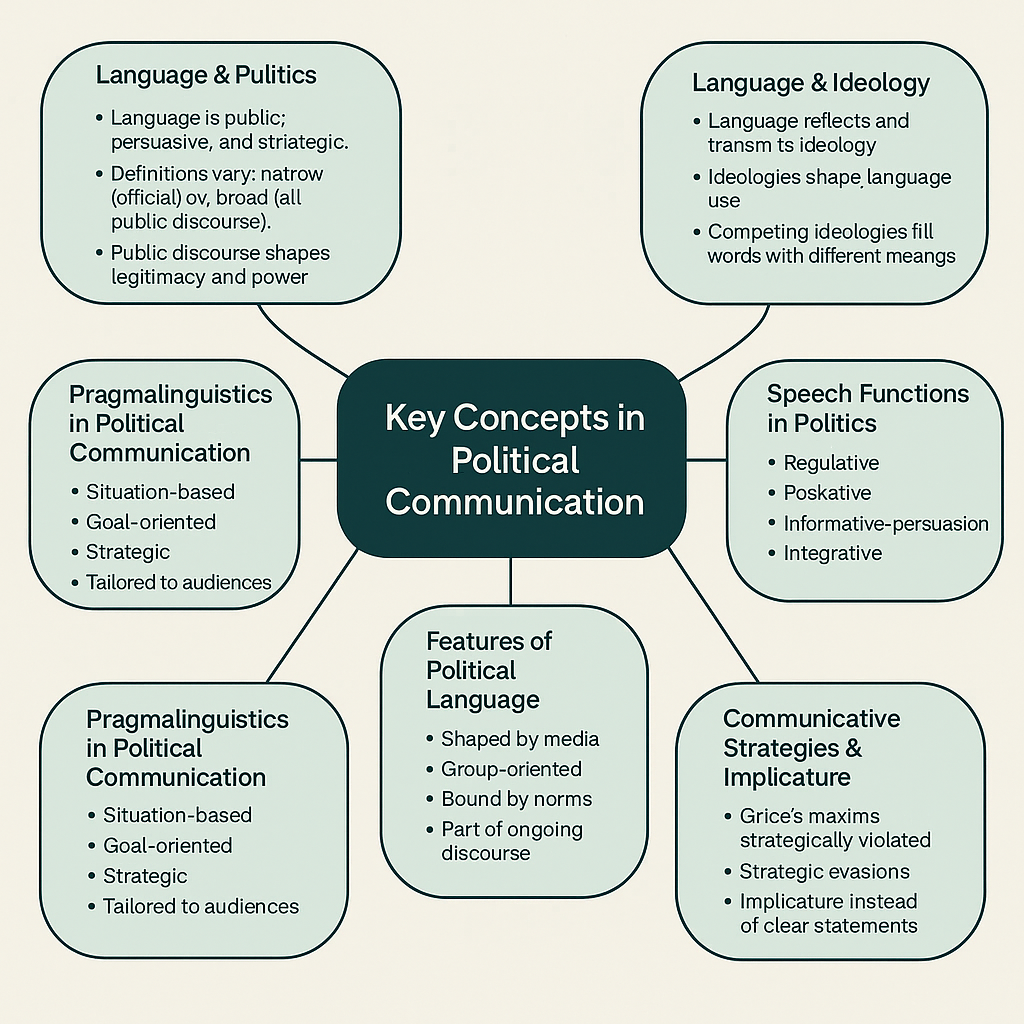
Language & Politics
- Language in politics is public, persuasive, and strategic.
- Definitions of politics vary:
- Narrow: limited to official state communication.
- Broad: includes all public discourse about politics.
- Public discourse shapes political legitimacy and power struggles.
✳️ Takeaway : Political communication is more than speeches — it’s the arena where power is built, challenged, and justified through words.
Language & Ideology
- Language reflects and transmits ideology — it is not neutral.
- Ideologies shape how language is used and understood.
- Words like “Blut and Boden” only become ideological in specific contexts.
- Competing ideologies can fill the same word with different meanings.
- The idea from Volosinov: “No ideology without signs”
✳️ Takeaway : Political language is ideologically loaded — it doesn’t just describe reality; it constructs it.
Pragmalinguistics in Political Communcation
- Language is situation-based, goal oriented, strategic.
- Communication is shaped by:
- Intention (e.g., gaining public support)
- Situation types (e.g., debate vs. interview)
- Strategies (e.g., framing, ambiguity)
- Partner hypotheses (assumptions about the audience)
- Text function (explicit vs. hidden aims)
✳️ Takeaway : Political communication is a series of strategic acts aimed at shaping opinion, often tailored to specific situations and audiences.
Features of Political Language
- Publicness & Mass Media:
- Political speech is public and media-driven.
- Politicians often perform for multiple audiences simultaniously (e.g., in parliament and on TV).
- Leads to “Inszenierung” (staging) and “Darstellungpolitik” (performative politics).
- Group Orientation & Representation:
- Politicians act as group representatives (own party vs. others)
- Use of strategic maxims:
- Portray self positively, opponent negatively,
- Appear capable and open-ended,
- Avoid alienating groups.
- Institutional Constraints:
- Political communication is bound by rules and norms (e.g., in debates or talk shows).
- Discursive Embeddedness:
- Political speech exists within ongoing discourses.
- Often seeks consensus, but may intentionally provoke dissent to shift the agenda.
✳️ Takeaway : Political language is shaped by media, institutions, audience expectations, ongoing debates.
Fields of Political Actions
- Political communication operates in various Handlungsfelder (fields of action)
- Public opinion,
- Intra-party discourse,
- Political campaigning,
- Institutional dialogue,
- Education, etc.
- Each field has typical text types (e.g., party program, speech) and strategies.
✳️ Takeaway : Political communication adapts to contextual settings, and each field has its own rhetorical patterns.
Speech Functions in Politics
- Girnth identifies four main Sprachfunktionen:
- Regulative — top-down governance (laws, decrees),
- Poskative — bottom-up demands (petitions, protests),
- Informative-Persuasive — explanation + persuasion (debates, campaign ads),
- Integrative — identity-building within groups (party programs commemorations)
✳️ Takeaway : These functions reflect power dynamics and guide how political actors achieve influence through language.
Communicative Strategies & Implicature
- Grice’s Maxims (truth, quantity, relevance, clarity) are often strategically violated:
- To evade, manipulate, reframe (e.g., irony, vagueness, redirection).
- Common political strategies:
- Ausweichen (evasion),
- Kaschieren (masking),
- Implikaturen (implications) instead of direct statements.
✳️ Takeaway : Politicians often don’t say what they mean directly — their speech is filled with strategic ambiguity.
Conclusion: The Power of Political Language
- Political language is performative, strategic, ideologically saturated.
- It’s central tool for shaping beliefs, identities, power structures.
- Understanding political communication means unpacking layers of speech, strategy, symbolism.
Klemm: (Audio)visuelle politische Rhetorik
Politics and Image/Film - A Complex Relationship
- Key Idea: Visual and audiovisual elements have always been integral to political communication, from historical symbols like coins and statues to modern photographs and films, used strategically to convey power and influence.
- Summary: Political discourse relies heavily on communication, with democracy requiring transparent information and discussion, while even dictators depend on effective rhetoric. Historically, verbal communication dominated research, but visual politics — strategic use of nonverbal elements like emblems, portraits, and propaganda — has been equally significant. Iconic images (e.g., Kim Phuc, Willy Brandt) shape collective memory and influence political discourse. Modern politicians use audiovisual self-presentation in mass media and social networks to appear competent and relatable, but this is criticized for risks of manipulation, oversimplification, and fostering a “mediocracy” or “symbolic politics”. Despite criticism, audiovisual staging is essential and unavoidable in democratic communication.
- Importance of Political Communication: Visuals are powerful tools for shaping public perception, but their suggestive nature raises concerns about manipulation, especially in polpulist contexts. Strategic image use is a core component of modern political rhetoric.
Theories and Methods of Analyzing Audiovisual Political Rhetoric
- Key Idea: Social semiotics and related frameworks like visual framing and multimodal discourse analysis provide systematic tools to analyze how audiovisual political communication constructs meaning.
- Summary: Early visual politics was studied through art history’s iconography and iconology, focusing on symbols and their contexts. Modern approaches, rooted in social semiotics (Kress/van Leeuwen), analyze multimodal interplay of images, texts, sound, and other signs. These frameworks examine representational, interactional, compositional functions of visuals, using techniques like vector analysis to decode spatial arrangements, perspectives, framing. For example, a 2007 photo of Angela Merkel between Putin and Bush uses positioning and gaze to signal alliances and distances, illustrating how images convey implicit political messages.
- Importance for Political Communication: These analytical tools reveal how politicians craft strategic narratives through visuals, enabling a deeper understanding of how images persuade and construct political realities beyond verbal rhetoric.
Media, Functions, and Factors of Multimodal Politics
- Key Idea: Politicians use diverse media (from coins to social media) to achieve functions like self-presentation, value symbolization, and citizen dialogue, with social media offering direct control but also new challenges.
- Summary: Visual politics spans historical media (emblems, paintings) to modern platforms (websites, Instagram). Social media allows politicians to bypass journalistic filters, controlling their image through professional photography and videos. Functions include projecting competence, transparency, and relatability, though visualizing abstract political work is challenging. Social media increases citizen interaction, but politicians face skepticism and the risk of missteps in “impression management.” Examples like Merkel’s casual Rügen photo or Obama’s intimate “Four more years” tweet show how visuals convey authenticity and emotional narratives.
- Importance for Political Communication: Social media transforms political communication by enabling direct, visually rich engagement with citizens, but it demands careful strategy to balance authenticity and professionalism while navigating public scrutiny.
Visual Politics: Photography and Text
- Key Idea: Standardized “image formulas” (e.g., politician at desk, with citizens) provide safe, recognizable ways to convey competence and relatability, bu deviations add individuality at the risk of misinterpretation.
- Summary: Politicians rely on familiar visual formats (e.g., “politician among the people”) to signal values like seriousness or accessibility. These “visiotype” use established symbols (e.g., suits for authority, listening poses for empathy). However, to stand out, politicians may break norms, showing private moments (e.g., sports, family) to highlight individuality, through this risks subversive readings (e.g., family photos seen as bourgeois). Text-image combinations on social media (e.g., Merkel’s Instagram post to Trump) enhance messages, with citizens amplifying or critiquing them virally. Examples like Sigmar Gabriel’s casual Twitter view photo show how private settings can project modernity and accessibility.
- Importance for Political Communication: Visual formulas ensure consistent messaging, but strategic deviations and text-image interplay on social media allow politicians to craft nuanced, engaging narratives that resonate with diverse audiences.