Introduction
-
General Introduction
- Incentives
- Providing meaningful incentives demonstrates to respondents that researchers understand the competing demands on their time and value their input. The effects of incentives, particularly when prepaid, are strongly established in survey research literature as effective tools for increasing response. However, effectiveness of incentives on web-administered surveys is less clear, and can be impacted by a number of factors, including incentive type and amount, timing, and mode of survey administration. ref_coopersmith2016
-
Types of Incentives and Their Differences (Table)
- Nature
- Monetary — cash, gift cards, vouchers, checks
- Non-monetary — small gifts, lottery entries, merchandise, feedback reports
- Social Incentives — donations to charity, helping research, contributing to science
- Timing
- Prepaid — $5 bill enclosed in the invitation letter
- Promised (Postpaid) — “You will receive a $10 gift card upon completion”
- Certainty
- Guaranteed — all respondents receive a voucher
- Lottery (Contingent) — entry into a draw to win an iPad
- Mode of Delivery
- Cash — banknotes or coins sent by post
- Electronic Transfer — PayPal, bank transfer, mobile payment apps
- Gift or Merchandise — mugs, USB sticks, branded items, e-books
- Coupon/Voucher — amazon, Starbucks, supermarket vouchers
- Combinations are also possible:
- Example: Prepaid cash incentive with an additional post-incentive for early completion
- Nature
-
Different Survey Modes and Incentives
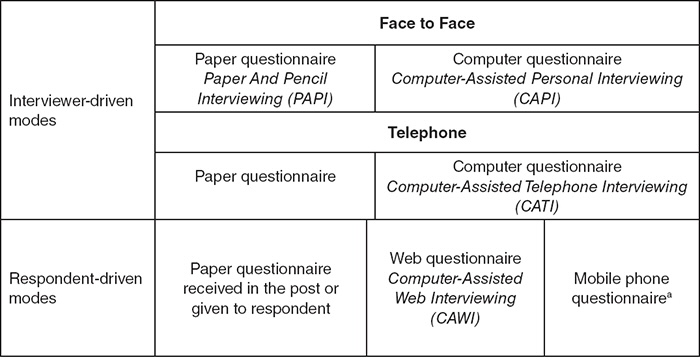 image from (Gray, 2015)
 -
General Consensus ref_singer2018
- Incentives are useful in making response rates higher
- Especially in self-administered ones
- Especially prepaid ones, in post surveys
- Social Exchange Theory (SET) suggests that offering prepaid incentives in surveys creates a sense of obligation in respondents to reciprocate by completing the survey, fostering trust and encouraging compliance. This theory is built on the principle that an initial “gift” (the incentive) creates a psychological expectation for a return favor, which in this case is survey participation. NOTE:
- The audience should be the main focus in designing the incentive program. You have to offer items that are of value to your audience. If your target audience is physicians, then you may need to spend more to get them to respond to your survey.
- Incentives are useful in making response rates higher
Focus
-
Web Surveys — Whys, why nots? (Sammut, 2021)
-
Advantages
- Working with a bigger sample size is less costly
- Less costly in general
- Digital, easy to work with data
-
Disadvantages
- No interviewer
- Non-contact is a big problem
-
Problems faced with, and possible solutions
- Response rates
-
-
Prepaid and postpaid
- Prepaid:
- Katılımcıya ödeme bağlantısı veya dijital hediye kartı, anket davetiyle birlikte gönderilir.
- Örnek “Amazon Gift Card kodu” e-posta ile gönderilir → kişi ankete katılsın ya da katılmasın, ödülü almıştır.
- Avantajı: Reciprocity etkisi (psikolojik geri ödeme isteği) yaratır.
- Dezavantajı: Parayı alıp ankete katılmama riski yüksek.
- Katılımcıya ödeme bağlantısı veya dijital hediye kartı, anket davetiyle birlikte gönderilir.
- Postpaid:
- Kişi anketi tamamladıktan sonra:
- Mail adresine ödeme bağlantısı gönderilir (PayPal, Amazon kodu vs.)
- Ya da, kişi IBAN bilgisi verir, araştırmacı havale yapar
- Bazı sistemlerde, otomatik puan birikimi ve sonra paraya çevirme sistemi
- Kişi anketi tamamladıktan sonra:
- Why focus on postpaid?
- lower upfront cost
- easier implementation in digital settings
- önceden ödenen teşvikler genellikle daha etkili, ancak sonradan ödenenler büyük örneklemler için daha uygun maliyetli
- Sonradan ödenen teşviklerin güven bağımlılığı ve web anketlerindeki uygulanabilirliği.
- Dezavantaj:
- practical challenges (e.g., trust issues or delayed delivery)
- Prepaid:
3 Experiments
Veen & Göritz & Sattler, 2016
- Veen, Floris Van, Anja S. Göritz, and Sebastian Sattler. 2016. “Response Effects of Prenotification, Prepaid Cash, Prepaid Vouchers, and Postpaid Vouchers: An Experimental Comparison.” Social Science Computer Review 34(3): 333–46. doi:10.1177/0894439315585074.
DeCamp & Manierre, 2016
- DeCamp, Whitney, and Matthew J. Manierre. 2016. “‘Money Will Solve the Problem’: Testing the Effectiveness of Conditional Incentives for Online Surveys.” Survey Practice 9(1): 1–9. doi:10.29115/SP-2016-0003.
Brown, et al, 2016
- Brown, Julie A., Carl A. Serrato, Mildred Hugh, Michael H. Kanter, Karen L. Spritzer, and Ron D. Hays. 2016. “Effect of a Post-Paid Incentive on Response Rates to a Web-Based Survey.” Survey Practice 9(1): 1–7. doi:10.29115/SP-2016-0001.
Concluding Remarks
Does incentives reduce non-response bias? (Hsieh, 2016)
- Response rates and non-response bias.
- Karışık bulgular: Teşvikler az temsil edilen grupları çekerek bias’ı azaltabilir, veya belirli demografileri çekerek artırabilir.
- Eleştirel analiz: Bias’ın azalacağı beklentisi neden tartışmalı?
- Demografik faktörler: Yaş, gelir, eğitim seviyesinin teşvik etkinliğine etkisi.
- Çıkarım: Teşvikler yanıt oranlarını artırır, ancak bias’ı azaltma garantisi yoktur.
Are incentives coercive?
Works Used:
Brown, Julie A., Carl A. Serrato, Mildred Hugh, Michael H. Kanter, Karen L. Spritzer, and Ron D. Hays. 2016. “Effect of a Post-Paid Incentive on Response Rates to a Web-Based Survey.” Survey Practice 9(1): 1–7. doi:10.29115/SP-2016-0001.
DeCamp, Whitney, and Matthew J. Manierre. 2016. “‘Money Will Solve the Problem’: Testing the Effectiveness of Conditional Incentives for Online Surveys.” Survey Practice 9(1): 1–9. doi:10.29115/SP-2016-0003.
Gray, Michelle. 2015. “Survey Mode and Its Implications for Cognitive Interviewing.” In Cognitive Interviewing Practice, 1 Oliver’s Yard, 55 City Road, London EC1Y 1SP United Kingdom: SAGE Publications Ltd, 197–219. doi:10.4135/9781473910102.n10.
Hsieh, Gary, and Rafał Kocielnik. 2016. “You Get Who You Pay for: The Impact of Incentives on Participation Bias.” In Proceedings of the 19th ACM Conference on Computer-Supported Cooperative Work & Social Computing, San Francisco California USA: ACM, 823–35. doi:10.1145/2818048.2819936.
Sammut, Roberta, Odette Griscti, and Ian J. Norman. 2021. “Strategies to Improve Response Rates to Web Surveys: A Literature Review.” International Journal of Nursing Studies 123: 104058. doi:10.1016/j.ijnurstu.2021.104058.
Singer, Eleanor. 2018. “Survey Incentives.” In The Palgrave Handbook of Survey Research, Cham: Springer International Publishing, 405–15. doi:10.1007/978-3-319-54395-6_50.
Veen, Floris Van, Anja S. Göritz, and Sebastian Sattler. 2016. “Response Effects of Prenotification, Prepaid Cash, Prepaid Vouchers, and Postpaid Vouchers: An Experimental Comparison.” Social Science Computer Review 34(3): 333–46. doi:10.1177/0894439315585074.